KASPARS OZOLINS | Associate Professor of Old Testament Interpretation, The Southern Baptist Theological Seminary and Life Assurance Ministries Board Member |
In my teaching at The Southern Baptist Theological Seminary, I delight to take students through the riches of the book of Isaiah (both in the original Hebrew and more generally in English). The book of Isaiah is absolutely breathtaking in its scope, its literary artistry, its themes, and above all, its principal subject: the majestic God of Israel who is coming to save his people. My students are frequently surprised to discover that the originator of many a line or quotation they might be familiar with from the New Testament—was in fact Isaiah. Similarly, so many of the themes that are developed in the new covenant Scriptures (the New Testament), are already present in Isaiah to a surprising degree. This surprise is doubtless due in part to the fact that we don’t know our Old Testament like we ought to (even those of us who are professors!).
A popular Adventist turn of phrase
A number of phrases in the book of Isaiah have also gone into the popular imagination, and they aren’t just limited to our favorite Christmas verses that we hear at Yuletide. I was recently musing about this as I recalled that the former Seventh-day Adventist GC president Ted Wilson used to repeat a line from Isaiah almost like a mantra: “Our church has long held to the Historical-Biblical or Historical-Grammatical method of understanding Scripture, allowing the Bible to interpret itself; line upon line, precept upon precept.” That last part should sound familiar, if you’ve heard even a few of Ted Wilson’s sermons. But he didn’t get it from Isaiah. At least not directly. Rather, it turns out that this line was a favorite of Wilson’s prophetess, Ellen G. White.
Here is only one example (among many that can be found in her voluminous writings):
“Our time is precious. We have now but few, very few days of probation left us in which to qualify ourselves for the future eternal life. We are not to devote these precious moments to forms and ceremonies. God designs that we shall keep the mind in pursuit of something tangible, something that we can take with us into the higher grade. The minds of the youth need the Word of God for instruction, that they may be ‘thoroughly furnished unto all good works.’ The teacher will need to be very simple when teaching from the Scriptures. They must be given line upon line, line upon line; precept upon precept, precept upon precept, here a little, and there a little.”—Letters and Manuscripts, vol. 11 (1896)
The language is somber and pious, yet meaningless, the more you think about it. After all, who reads the Bible (or any book, for that matter) in any other way than “line upon line”?
The Mormon connection
I recently discovered that this phraseology was being exploited by more than one nineteenth-century prophet. The prophet of the Latter-day Saint movement, Joseph Smith, allegedly received from the angel Moroni the following message:
“For behold, thus saith the Lord God: I will give unto the children of men line upon line, precept upon precept, here a little and there a little; and blessed are those who hearken unto my precepts, and lend an ear unto my counsel, for they shall learn wisdom.”—(2 Nephi 28:30)
My curiosity piqued, I did an N-gram search on Google and discovered that this phrase skyrocketed in popularity in nineteenth-century written sources, only to plummet in usage by the beginning of the next century. (Ironically, the phrase peaked in 1844, though I think this is probably not to be taken as connected with the Great Disappointment.) To be fair, the phrase is not limited to Mormon or Adventist sources; it also shows up in a number of other Victorian-era writings. Yet the “prophetic” writings of Ellen G. White and Joseph Smith have a unique authority claim upon their readers. Only their writings claim to be divine in origin; so it matters how they quote from Scripture, in this case, Isaiah.
Isaiah’s original context
The phrase in question belongs to Isaiah 28:10, which reads as follows: “For it is precept upon precept, precept upon precept, line upon line, line upon line, here a little, there a little.” Isaiah 28 is part of a larger section in this massive book: chapters 28–35. This section is significant for its six “woes” which indict God’s people for trusting in foreign powers (chiefly Egypt) and human devices, instead of trusting in the God of Israel.
Judah faced a terrible menace in Isaiah’s day, the world’s first true empire: Assyria. This colossal military might was infamous for its cruelty, ripping open pregnant women, flaying the skin of captured enemies, or impaling them along a city wall. Judah’s king at the time, Hezekiah, had experienced the trauma of the destruction and deportation of the northern kingdom, Israel. Now tiny Judah stood alone against an unstoppable enemy from the east. But God’s people refused to listen to Isaiah, and they refused to heed his warnings.
In fact, within its immediate context, Isaiah 28:10 turns out not to be the prophet’s words, but rather those of his drunken mockers! Here is that context (vv. 7–8):
“These also reel with wine and stagger with strong drink; the priest and the prophet reel with strong drink, they are swallowed by wine, they stagger with strong drink, they reel in vision, they stumble in giving judgment. For all tables are full of filthy vomit, with no space left.”
And these are the actual mocking words of those who scoffed at Isaiah (v. 9):
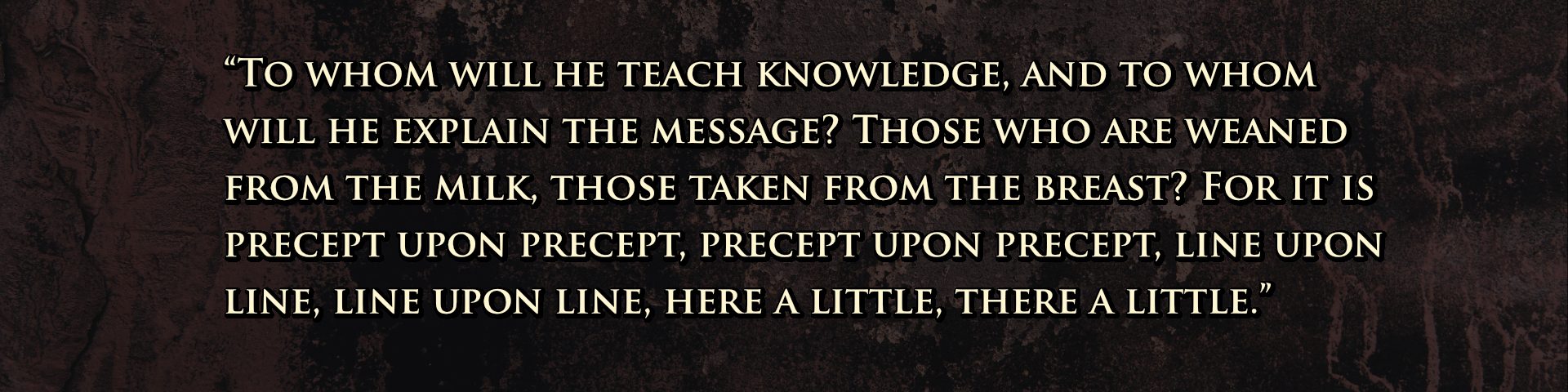
“To whom will he teach knowledge, and to whom will he explain the message? Those who are weaned from the milk, those taken from the breast? For it is precept upon precept, precept upon precept, line upon line, line upon line, here a little, there a little.”
They are effectively saying that Isaiah’s message is only fit for babies and toddlers, not them! Unfortunately, this Hebrew phrase is somewhat obscured in the English KJV tradition. Here it is in transliteration: tsaw la-tsaw, tsaw la-tsaw, qaw la-qaw, qaw la-qaw. Perhaps a more accurate impressionistic equivalent would be to imagine the mockers chanting the following: “A-B-C-D-E-F-G…now I know my ABCs!”
Bible ABCs
As I mentioned earlier, the unfortunate misinterpretation of this peculiar verse is not limited to the cults. One even still hears it misused here and there in certain evangelical circles. But unlike cultic movements, churches that truly submit to the Scriptures can be corrected and reformed by the Word of God, since they are bound by it. Seventh-day Adventism, on the other hand, despite claiming to be a “Sola Sciptura” movement, is beholden to its nineteenth-century prophetess, along with all her misuse and twisting of Scripture. An Adventist leader like Ted Wilson can hold up the Bible like a prop and claim to revere it, even as he continues to not only quote from Ellen G. White, but even mimic her speaking style.
Many lessons can be learned from this example. Let’s not fall into the trap of claiming to follow the Bible and esteem it as our ultimate source of authority, while neglecting to truly study it and know it. Sadly, much of evangelicalism in America today is ignorant of the Word of God. To the degree that it is, it will misuse the Bible and fail to recognize false teaching. But God has spoken in his Word. We can know his Word. As blood-bought believers in Jesus, we are duty-bound to not only understand the Word of God, but also to follow it and conform our lives to it. May we commit ourselves anew to this great task.
“But as for you, continue in what you have learned and have firmly believed, knowing from whom you learned it and how from childhood you have been acquainted with the sacred writings, which are able to make you wise for salvation through faith in Christ Jesus.” (2 Timothy 3:14–15)

- Misquoting Isaiah Line Upon Line - October 15, 2026
- Who Is the Blessed, Happy Man? - August 27, 2026
- Fellowshipping with Babylon: The Adventist Theological Society at ETS - July 9, 2026