
MOSES DRAKE LUSWATA | Former Adventist Pastor in Uganda |
Editor’s note: Moses’ piece may seem extreme to many North American readers. Much of what he describes may resonate with those who remember traditional Adventism from the 50s and 60s (or even before!) While the North American church has made many external changes over the past few decades, still traditional Adventism is being taught in many areas of the world—and even in North America, the core doctrines have not changed. Moses shares his current experience with Adventism in Uganda, located in East Africa.
When a person listens to the preaching in Adventist evangelistic crusades, it is easy to think that Adventists are near the gates of heaven, and one is compelled to join them. At face value they seem to be “the people of the Book” (The Bible) as they claim, and, because of the brainwashing and the proof-texting drills one undergoes, it’s almost impossible, at first, to discover that Adventists’ systematic theology is built on fables, not on the truth of the Scriptures. At one time I was a victim of this evangelistic deception, but I thank God the veil which they had put on my spiritual eyes was removed in Jesus Christ. “Even to this day when Moses is read, a veil covers their hearts. But whenever anyone turns to the Lord, the veil is taken away” (2Cor 3:15, 16).
Remnant
At the age of 15 I was baptized into the faith of Adventism. I was filled with joy thinking that I had escaped the wrath of God by coming out of Babylon into the Adventist church. The 27 Fundamental Beliefs (revised to 28 Fundamental Beliefs in 2005) were introduced to me, and among these was the doctrine of “the remnant”. When the church elder taught the new converts this doctrine, I loved it. It put me in a situation where I, a person considered to be “less privileged”, was suddenly elevated to new status; I was now one of the REMNANT of GOD. Statements such as the following made me feel I was not only a special person but also a unique person:
“The Bible portrays the remnant as a small group of God’s people who, through calamities, wars, and apostasy, remain loyal to God”(Seventh-day Adventists Believe, second ed., 2005, p. 190, par. 3).
“God’s remnant people are characterized by a faith similar to that which Jesus had” (ibid., p. 191, par. 1).
“Genuine faith in Jesus commits the remnant to follow His example” (ibid., p. 191, par. 3).
“In every church [during the late 18th and early 19th centuries] believers in the imminent return of Christ could be found, all praying, working, and anticipating the climax of the ages” (ibid., p. 192, par. 1).
“The Advent movement was a truly Biblical interconfessional movement centered in the Word of God and the Advent hope” (ibid., p. 192, par 2).
When a person is still veiled with this teaching, it looks like the absolute truth. One believes one has to work hard to maintain and keep him/her self in the remnant of God. This doctrine shaped me into a unique person, and little by little I became enmeshed in remnantism. I reached a point of looking at non-Adventists as the lost, the unclean, and as those destined to destruction at the Second Advent.
Marks of the remnant
After I graduated as a Bible instructor from Nabiyagi (Emiti) Bible college, I started zealously teaching the 27 fundamental doctrines. I put more emphasis on the doctrines of the remnant and the Sabbath because these two, to me, most defined our identity as a unique and special group of God’s people. I never thought—moreover, it would have been too hard for me to believe—that other Christians who are not Seventh-day Adventists could ever be saved. I based my belief on the remnant hypothesis that Revelation 12:17 refers to Adventists: only those who keep the 10 Commandments of God and have the testimony of Jesus (which we identified as the ongoing prophetic ministry of Ellen White) will be saved. Apart from meeting those qualifications, other so-called Christians are lost. After all, the Bible tells us so:
“For wide is the gate and broad is the road that leads to destruction, and many enter through it. But small is the gate and narrow the road that leads to life, and only a few find it” (Matt 7:13-14).
Whenever I looked at the other Christians who numbered far more than Seventh-day Adventists, I ignorantly used Matthew 7:13-14 as my proof text, as I had been taught, that Adventism is the narrow way because it comprises the small remnant, and the other Christians are on the wide way which leads to hell.
I remember one evening after preaching in an evangelistic crusade and making a strong appeal to my listeners to get out of Babylon and come and join the remnant church, a young girl came to me and told me, “I would join your church because you preach well, but you have too many ‘do’s’ and ‘don’ts’.” I told this young girl that if she wanted to be saved, she didn’t have any options besides becoming an Adventist or being lost. With this legalistic attitude, I lost many souls who would have accepted Christ.
This spirit of remnantism looks to be godly, but it is a demonic spirit; it keeps someone who is under its power in a religious bondage that leads one to disassociate himself from other Christians and to become unique in behavior. Remnantism requires one to understand God differently from the way He is described in Scripture. At times, remnantism requires adherents to change jobs so they can be good observers of the law.
I remember I reached a point of not eating anything cooked at my relatives’ houses because their cooking utensils had been used to cook pork and other unclean foods. My belief in the strict observance of the dietary restrictions of Adventism had isolated me. In our culture it is an abomination not to eat at one’s relatives’ house when visiting. To avoid this social abomination, I decided not to visit my family, and eventually I ended up almost losing them.
Remnant isolation
I found that a Seventh-day Adventist feels better associating with a fellow Adventist than with his family members who are not Adventist. Because of the remnant attitude, one ends up creating another family because he or she no longer “fits in” with others who are not Adventists. As an Adventist, one can’t go to their functions, yet functions here in Africa are one of the ways we strengthen our relationships. Using Romans 1:32b as our Scriptural proof text, “they not only continue to do these very things but also approve of those who practice them,” Adventists had to separate themselves from family gatherings and from non-Adventist friends.
As a special group—as the “remnant”—we were taught that all functions which were not prepared and organized by Adventists were not godly. If, as Adventists, we were to go and participate in—thus blessing—non-Adventist occasions, we would become part and parcel of all evils done in that function. Consequently I ended up not attending any function apart from those organized by the Adventists.
While Adventist functions were considered the only appropriate activities for an Adventist to attend, many evil things often occurred in those gatherings. For example, one time a young unmarried girl was brought to the church board because she was pregnant. When this girl was asked how she became pregnant, she replied that it had happened at camp meeting. In fact, many similar cases have been found to have occurred at camp meeting, even to date.
If our use of Rom 1:32b as a proof-text commanding abstinence from all non-Adventist functions were valid because of guilt by association, then all those Adventists who attended camp meetings and other functions where such evil things occurred should also be considered guilty of them. I ask myself why I couldn’t reason so clearly at that time!
With a “remnant attitude” one finds oneself not associating with other people who are not Adventists—including relatives—not because one doesn’t want to, but because of fear. Because this doctrine is built on fables and not on Biblical truth, there is little likelihood that a non-Adventist Christian will examine it. Thus the Adventists take this doctrine for granted without encountering dissenting opinions although it is robbing them of their freedom in Jesus Christ for which they long.
The unveiling begins
I thank God that I joined Bugema University, an Adventist university in Kampala, Uganda. This move was the beginning of the unveiling of my spiritual eyes. While in Bugema, I discovered that the doctrines of Seventh-day Adventists were full of ambiguities. This growing realization stirred many doubts in me, and I could not rest until I reached the core of these doctrinal discrepancies. The more I researched these doctrines, the more God led me into deeper study and discovery of many things. At first I thought I was just doing research and studying for the sake of studying. I did not realize that God was leading me to the freedom He promised to His true believers—that I would know the truth, and the truth would set me free. I thought that things would be simple, that I could dismiss the problems and keep the truth. Every day, however, I got up to read my Bible, and new revelations started coming to my mind. I never imagined that I would ever leave Adventism, but I finally vowed that when I finished my Bachelor of Theology, I would never preach from E G. White’s books again. I would only preach the gospel alone from the Bible alone.
One day while I was still in the state of confusion, a professor from the theology department came to our class and made this statement, “I cannot honor and respect the writings of the prophetess of the church because they are full of lies.” Another time he came to our class and told us, “You people, you go around boasting that you are the remnant of God. That is not true. You are just a faction of Christendom. God will save even other Christians in the other sects in the same manner as He will save you!”
As if that were not enough, he made another statement, “You people—you go on saying that Jesus is coming soon. Where is He coming, and to do what? The gospel is not yet preached, and you think that Jesus is coming! I pity you, you Adventists pastors, when you leave here to go back and preach what you call the gospel. Stop preaching soyameat and all those nonsense sermons!” If I were to tell all the statements this professor made, they would be nearly endless; he made my life so difficult! Because of his challenging teaching, I found myself concentrating more on researching my faith in this so-called “only True and Remnant Church of God” than on studying my academic books to pass my examinations. It was almost funny; the more I researched, expecting to find the solutions to my questions, the more truth hit me hard. I started seeing the doctrines which I liked the most flying away one by one, like butterflies from my hands.
The last two doctrines
I could not believe that the Sabbath and Remnant doctrines would also fly away. I clung to them tightly. I could let other doctrines go, but not these two! The time came, however, when I finally had to let the Remnant also go, but Sabbath stayed for a while. I resigned from my Adventist pastoral duties, but still I kept on fellowshipping on Saturday. I reasoned like this: after the work of redeeming man, Jesus accomplished this work on Friday, and on Sabbath (Saturday) He rested in the grave. Therefore, as Christians, we have to rest on that day in order to commemorate that great work which no human being could do—restoring and reconciling a sinner to God, His Creator. On the surface this reasoning seems to make sense, but when I read other books from other authors such as Sabbath in Christ by Dale Ratzlaff, the series Judeo-Christianity Challenged By Paul by Samuel Pestes, A Theologian’s Journey by Jerry Gladson, New Covenant Christians by Clay Peck, and the more recent one by Pastor Greg Taylor, Discovering The New Covenant, I found out that my reasoning vanished into thin air.
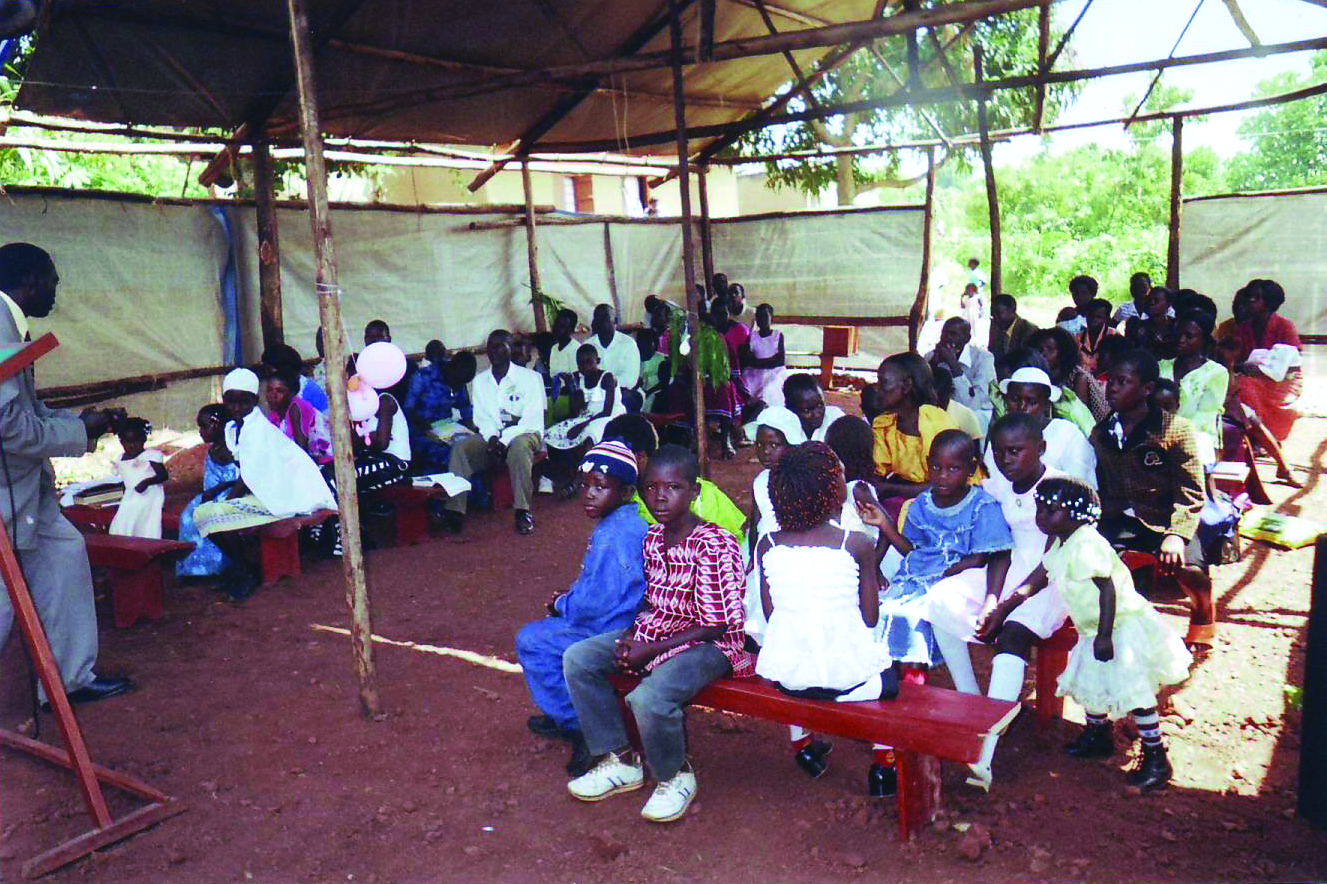
When a person is still blinded by legalism, he cannot realize the dangers of remnant theology, but let a person leave such a group—then he or she will suffer the consequences of it. The very doctrines I cherished now worked against me. I became isolated even more than before. I could not go back to Adventism now that I had studied it deeply, but other Christians rejected me thinking that it would be too hard for me to leave Adventism and I would go back. Others said that I was spying—and if not spying, that I was masquerading as a Christian and had really come to destabilize Christianity. Because of the remnant theology I had cherished so much, I had finally reached a point of having no friends but Adventists, and now I was leaving even them.
When I stood out boldly to oppose them, I had no choice but to resign from their service. At first things were not too hard for me because Life Assurance Ministries started giving me assistance. For almost one year LAM provided support for me and my four colleagues as we tried to start a ministry. Despite some persecution from the so-called “church”, I did not feel the effect of abandoning the remnant. Things changed immediately, however, after our group of five mishandled our situation. The ministry we tried to put up collapsed; LAM stopped the assistance, and the whole group scattered. Then I began to see how hazardous the teachings I cherished were.
But God is faithful.
Remember, because of “remnant teaching”, I believed I was special and unique. I didn’t have any dealings with anyone apart from Adventists. At the same time, my name was already being read in the churches around the Central Uganda Field of Seventh-day Adventists, and all the remnant people were repelling me. I was alone. Life became too hard, and I reached a point of joining a denomination I well knew was worse than the one which I had left. In spite of all the pain, however, one thing I didn’t contemplate was going back to Adventism!
It took me one and a half years without genuine friends before I began to emerge from the darkness. The worst of my experience was that the remnant people were mocking and laughing at me. I could hear them saying, “This Church is the remnant of God, and those boys are suffering because they tried to destroy it. No one lays his/her hands on this church and gets away without the punishment of God. God has to defend His church—and that defense is just the beginning of what He will do!” Such statements were made, but they didn’t move me because I had finally found rest for my soul in Jesus Christ.
Resolution
Because of my “remnant mentality”, I had hated reading any other books apart from books which were written by Adventist writers, especially E. G. White. We were told that the Beast is using many people to write books which are misleading, and we should avoid them. For many years I ignored treasured and spiritually packed books because they were not written by Adventists. Many times before I would buy a book, I looked first to see if the author was an Adventist. If not, the book had no value to me. The spirit of legalism had blinded me, I didn’t know that I was ignoring literature which could bring freedom, peace, and the full knowledge of understanding the free gift of God which is in Jesus Christ. I thank God today I have an independent mind. I read many spiritual books, and I have found statements in those book which have brought happiness to my soul.
It has cost me a period of one and a half years of loneliness and grief to find new Christian friends who can trust me. What amazes me is that during the time of my isolation, not even a single pastor with whom I used to serve in the Adventist church came to my home to say a word or to try to woo me back to Adventism! Do you see how the doctrines of this church, instead of creating love, sympathy, unity and care for others, actually create enmity? By teaching its people remnant theology, Adventism has made people think that they are fighting for God when in reality they are endangering themselves and keeping other Christians at arm’s length.
I thank God for the gospel of the New Covenant. Now I look at all Christians as God’s people, and I am not special or unique from them. I no longer preach condemnatory sermons but rather call all Christians to look at the cross where there is hope for the sinner. Because of the gospel of the New Covenant I realize that the Remnant of God is not measured by our human understanding of what people can do. Rather, it is determined by the act of God at the cross, and whoever believes it, regardless which church he/she attends, is part of the remnant of God.†
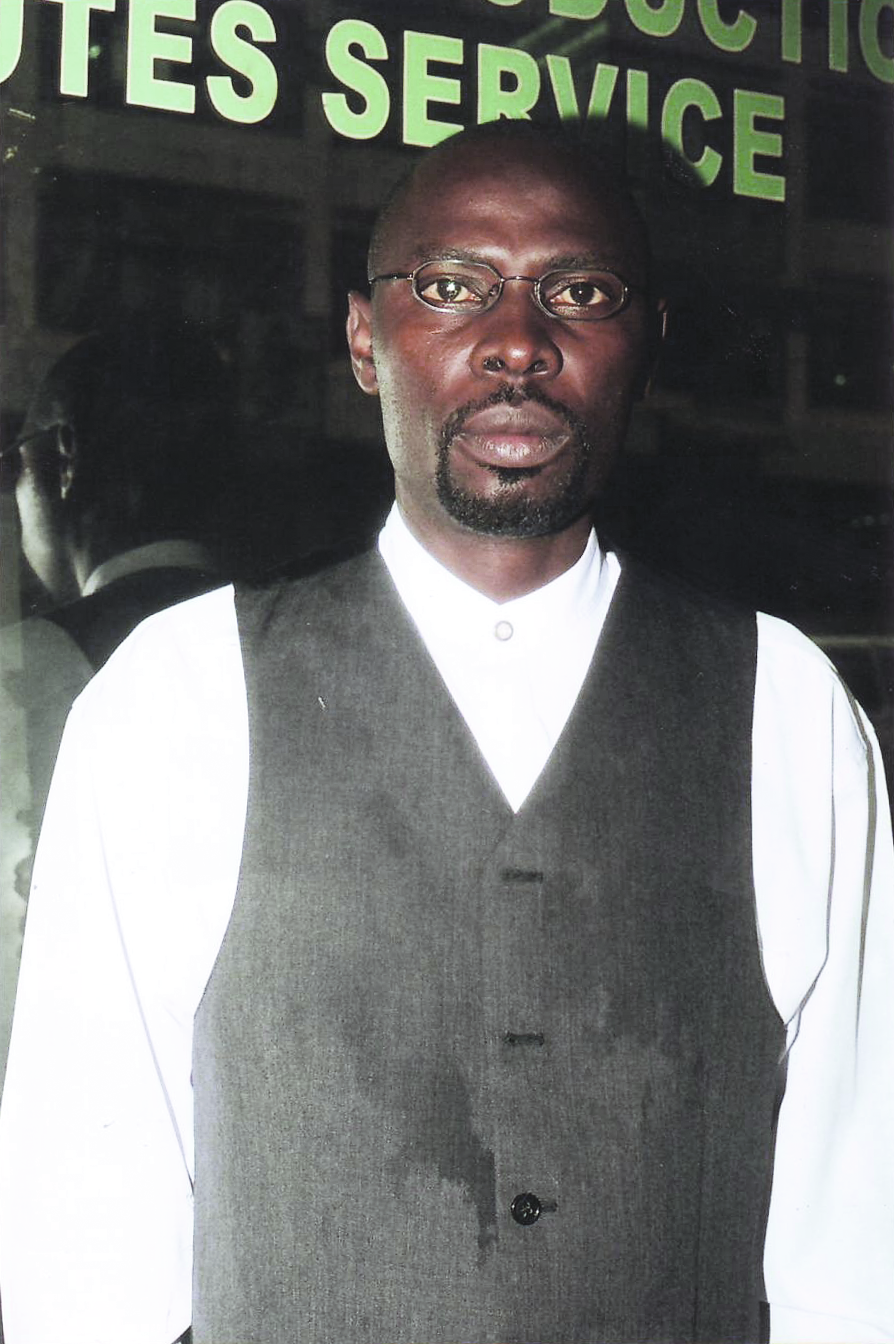
Moses Drake Luswata is the pastor of Grace Place Community Church in Kajansi, Uganda.. He is also the coordinator for One Flock Ministries (directed by Greg Taylor) in Africa. He and his wife Jane have five children: Idah, Esther, Joshua, Florence, and Juliana. [2007]
—Republished from Proclamation!, January/February 2007.

- I Am Not a Spiritual Israelite - October 15, 2026
- I Found My True Savior - September 24, 2026
- I Found Rest in the Journey - August 27, 2026
In Australia where Adventist churches are in close proximity, the situation arises where one is conservative and the other is liberal. In the state of New South Wales where I once lived, Wingham was considered liberal by Taree. The town’s were 15km apart. EGW said whole Adventist churches would be lost at the end of time. The destroying angel flying over those lost Adventist churches will cry “ Ichabod “ the glory has departed. Taree considered Wingham to be an Ichabod church.
I now live in the state of Western Australia. Albany is considered liberal by Mount Barker. The distance between the towns is 52km and Albany residents worship in Mount Barker.
The fruit of the ministry of EGW has turned Adventism into a circus. Adventism is the only circus on in town and it’s on every week.